Buying a Waterfront Home With a Dock, Bulkhead, or Seawall in Virginia Beach: What Should You Inspect?
TL;DR
When you buy a Virginia Beach waterfront home with a private dock, boat lift, bulkhead, or seawall, you are buying more than a house and a water view—you may also be taking responsibility for marine structures, shoreline stabilization, permit history, future repair or replacement, water access, dredging needs, and property-specific flood exposure. A standard home inspection is an important starting point, but waterfront improvements deserve their own due diligence: examine the dock's pilings, framing, decking and hardware; have boat-lift and waterfront electrical components evaluated where appropriate; look for deterioration, movement, erosion or loss of soil around a bulkhead or seawall; verify that existing improvements match available surveys and permit records; determine whether the water is actually deep and navigable enough for the boat you intend to keep there; investigate who pays for dredging or shoreline work; and obtain realistic estimates before an inspection or other contractual deadline expires. In Virginia Beach, waterfront construction can involve local building requirements and coordinated wetlands and waterway review, while Virginia's shoreline-management rules can also affect how a deteriorated shoreline structure may eventually be repaired or replaced. The goal is not to make waterfront ownership sound risky—it is to make sure the dock, shoreline and water access you are paying a premium for actually work, are supportable, and fit the cost of ownership you expect.
The Dock Is Part of the Property Decision, Not Just an Amenity
On a waterfront listing, the dock is often photographed like an outdoor living space: sunset, chairs, boat tied alongside, water behind it.
A buyer needs to look at it differently.
If the dock is one of the reasons you are choosing that property over another home, its condition, legal status and actual usefulness deserve the same seriousness as the roof, HVAC system or foundation.
That does not mean every dock requires a complicated engineering study. It means you should not assign thousands of dollars of personal value to the phrase “private dock” until you understand exactly what comes with it.
This article intentionally goes deeper on that one issue than our broader Luxury Waterfront Homes in Virginia Beach buyer guide, which looks at the complete waterfront purchase. Here, the question is narrower: what are you actually acquiring at the water's edge?
When I am comparing two waterfront properties for a buyer, I would rather know early that one has a well-documented, functional dock and the other has a waterfront structure approaching a major decision point. Those homes may deserve very different comparisons even if the houses themselves are similar.
Inspect the Dock From the Pilings Up
A general home inspection may identify obvious dock problems, but buyers should discuss the scope with their inspector before assuming every marine component will be evaluated. When condition is uncertain or the dock materially affects the purchase decision, a marine contractor, structural professional or other qualified waterfront specialist may be appropriate.
Start below the attractive decking.
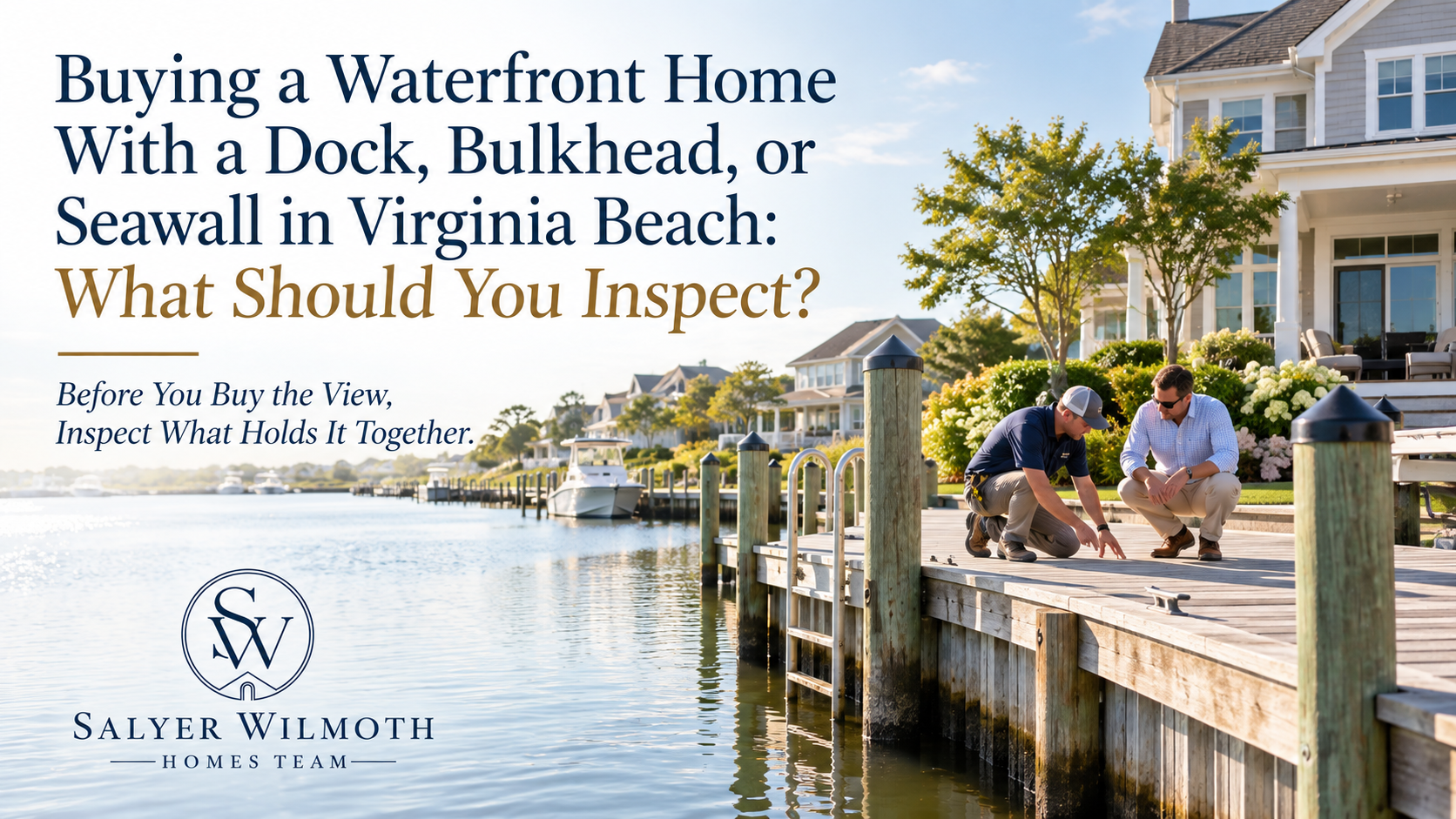
Look at the pilings and how consistently the structure sits over the water. Ask about visible deterioration near the waterline, loose or shifting sections, damaged framing, deteriorated caps or stringers, corroded connectors and fasteners, uneven decking, movement under foot, damaged ladders or steps, and repairs that appear newer than the surrounding structure.
The question is not simply, “Can I walk on it today?”
The more useful question is, “What will this dock require during the years I expect to own the house?”
This is where our Home Inspection Surprises in Hampton Roads guide becomes relevant. A significant inspection finding is not automatically a reason to abandon a property. It is information that may affect price, negotiations, specialist evaluations, repair planning and the buyer's comfort with the transaction.
Treat the Boat Lift and Waterfront Electrical System as Separate Components
If a boat lift is included, find out what it was designed to handle rather than assuming it will work for whatever boat you plan to own.
Ask for available manufacturer information, capacity documentation, repair history and invoices. Examine the pilings and supporting structure along with the lift itself, and consider professional evaluation of cables, pulleys, motors, controls, bunks and other operating components when condition or capacity is uncertain.
Electrical service near water deserves separate attention as well.
Virginia Beach identifies new wiring, changes to wiring and electrical-service work among activities requiring electrical permits. For a dock with power, lighting, outlets, a lift or other electrical equipment, having an appropriately licensed professional evaluate questionable installations can be far more useful than relying on appearance alone. City of Virginia Beach
I would also want a buyer to operate the features that matter whenever the contract and inspection arrangements permit it. A lift that “comes with the house” has very different value if nobody can demonstrate that it functions properly.
Inspect the Bulkhead or Seawall for What Is Happening Behind It
Bulkheads and seawalls can be easy to underestimate because much of their job is quiet: holding soil in place and protecting the edge of the property.
That is exactly why the ground behind the structure deserves attention.
Virginia Institute of Marine Science guidance identifies several warning signs associated with failing or flanked bulkheads, including loss of backfill or sinkholes along the top, bowed or leaning sections, deteriorated timber or pilings, missing sheet piles, and erosion behind, above or around the ends of the structure. Virginia Institute of Marine Science
Those are not conditions I would want a buyer to dismiss as cosmetic landscaping.
For concrete, masonry or other shoreline structures, cracking, displacement, undermining, soil loss or obvious changes in alignment also warrant professional attention. The exact cause and significance should be determined by someone qualified to evaluate the structure and shoreline conditions rather than by the real estate agent.
VIMS recommends considering structural integrity, remaining life expectancy and the level of protection provided by existing shoreline structures, with expert advice where appropriate. Virginia Institute of Marine Science
A waterfront home can have a beautifully renovated kitchen while carrying a shoreline problem that is much less visible in listing photography.
Verify the Permit History Before You Pay a Premium for the Improvements
Do not assume that an old dock, bulkhead or boat lift is automatically compliant because it has been there for years.
Virginia Beach specifically identifies waterfront construction—including bulkheads, piers, boat lifts and riprap—as work requiring building-permit review, and properties in areas such as flood zones or Chesapeake Bay Preservation Areas may require additional environmental approvals. City of Virginia Beach
The City's Wetlands Board guidance states that waterfront construction and dredging projects involving docks, bulkheads and similar structures go through the Joint Permit Application process, which coordinates review among relevant agencies. The U.S. Army Corps of Engineers likewise identifies piers, boathouses, bulkheads, shoreline stabilization and other work in tidal waters among activities handled through Virginia's JPA process. City of Virginia Beach
There are nuances and statutory exceptions for certain private piers, so buyers should not try to determine legal status from a general article alone. Virginia law, for example, contains specific provisions for qualifying private noncommercial piers and certain replacement work. Virginia Law
That is why I would rather see the actual records for the particular property.
Ask for whatever is available: surveys, permit numbers, approved plans, completion documents, contractor invoices, warranties, prior repair records and documentation for the lift or other waterfront improvements. Then compare that information with what physically exists.
Virginia's current residential disclosure framework also places substantial responsibility on purchasers to conduct their own investigation into property condition and improvements rather than assuming the standard disclosure answers every question. Virginia DPOR Our 2026 Virginia Residential Property Disclosure guide explains that buyer-due-diligence framework in more detail.
A Failing Bulkhead May Not Be as Simple as “Replace It Later”
This is one of the most important differences between inspecting an ordinary exterior improvement and evaluating shoreline infrastructure.
A buyer may see an aging bulkhead and mentally budget for replacing the same wall in the same place sometime after closing.
Virginia's current shoreline policy makes that assumption worth checking.
State law establishes living shorelines as the preferred alternative for stabilizing tidal shorelines and directs the Virginia Marine Resources Commission to permit living-shoreline approaches unless the best available science shows they are unsuitable, in which case permitted projects are still expected to incorporate living-shoreline elements to the maximum extent possible. Virginia Law
That does not mean every existing Virginia Beach bulkhead must immediately be removed or that every repair will require the same treatment.
It means a buyer should not automatically assume that a future major shoreline project will be a simple like-for-like replacement with a predictable scope.
If the structure looks close to needing substantial work, I would want a qualified shoreline contractor or consultant to help the buyer understand the condition and likely options before the buyer treats that improvement as somebody else's future problem.
Confirm That the Dock Actually Works for Your Boat
“Dock included” and “usable boating access” are not the same thing.
If boating is one of the main reasons you are purchasing the home, determine how the water behaves at the property—not only how it looks during the showing.
Water depth can change with tide and sediment. The route from the dock to navigable water matters. So can dock configuration, boat draft, lift capacity, bridge clearance and conditions farther along the waterway.
Ask what the owner keeps there now and verify rather than assuming the same setup works for your boat.
Virginia Beach's neighborhood dredging program illustrates why this matters. In participating areas, the City describes neighborhood-channel dredging separately from an individual owner's access basin connecting a private pier or dock to the channel. Owners who want those individual access basins dredged may have to fund that portion themselves. City of Virginia Beach
So if a listing says “deep water,” I would not stop at the marketing description.
I would want the buyer to know what depth and access actually exist where the boat will sit, whether dredging has historically been needed, what channel maintenance arrangements apply, and what ownership costs could arise later.
Flood Risk Still Matters Even When This Is a Dock Article
This should not become another generic flood-risk guide, but it would be incomplete to evaluate a shoreline structure without looking at the property around it.
Virginia Beach notes that heavy rain, hurricanes and nor'easters can create flood risk across the city and that development within Special Flood Hazard Areas is subject to additional requirements. The City also provides property-specific flood-zone determinations, while elevation certificates can document how the home's elevation relates to expected flood levels. City of Virginia Beach
For a waterfront buyer, I would look at the house and shoreline together.
Where are the HVAC equipment and utilities? How does the yard drain? Does water appear to collect behind the bulkhead? Is erosion visible near the ends? What is the elevation of the structure? What insurance quote does the buyer actually receive for this specific address?
If the Chesapeake Bay side of the city is part of the search, our Shore Drive Virginia Beach buying guide goes further into flood zones, elevation, insurance and coastal-property considerations.
Review the Survey, Boundaries and Responsibility for the Shoreline
Waterfront ownership can create another question buyers do not face with every house: what exactly belongs to this parcel, and who is responsible for maintaining it?
A current survey can help identify property boundaries and the location of physical improvements. Title documents, easements and association documents may also matter.
For a detached waterfront property, determine whether the dock, pier or shoreline structure serving the home is entirely associated with that property or subject to shared arrangements, recorded rights or other limitations.
For an HOA or condominium property, identify whether the structure is individually owned, commonly maintained or subject to association control.
I would not rely on a listing photo, fence line or seller's informal explanation when the dock itself is a material reason for buying the property.
The documentation should support what the buyer believes they are acquiring.
Get Repair Estimates Before the Finding Becomes Your Problem
If the dock or shoreline inspection identifies a material concern, the next question is not automatically, “Will the seller fix it?”
First determine what the problem actually is.
A qualified contractor or specialist may need to clarify whether the issue is routine maintenance, localized repair, structural deterioration, erosion, permitting-related work or a larger replacement project.
Then obtain realistic estimates where timing allows.
That information can affect how a buyer evaluates an offer, an inspection negotiation, a seller credit where legally and contractually appropriate, a price adjustment, or simply the decision to proceed.
The waterfront premium should be evaluated against the waterfront responsibility.
That is especially true when comparing properties at different price points. A home with the less impressive dock today may ultimately be the stronger purchase if its shoreline infrastructure is documented and serviceable, while another home's picture-perfect waterfront setup may come with significant work approaching.
For buyers looking at a second home rather than a primary residence, our broader Virginia Beach Waterfront Vacation Home Buyer's Checklist adds rental, insurance, carrying-cost and absentee-ownership considerations to this inspection-focused analysis.
How We Approach a Virginia Beach Waterfront Purchase
Salyer Wilmoth Homes' role is not to replace the marine contractor, engineer, surveyor, attorney, insurer, city official or home inspector.
It is to make sure the real-estate decision is organized around the right questions.
Michele Salyer's professional background includes more than 20 years of combined real-estate sales and legal experience, with buyer representation and waterfront-property guidance among the services described by the team. Atlantic Sotheby’s International Realty
For a property with a dock, bulkhead or seawall, that means helping the buyer compare the property against other waterfront options, identify which features materially affect value and usability, request relevant documentation, coordinate inspection and contract deadlines, bring in specialized professionals when a finding goes beyond ordinary home inspection, evaluate repair information in the context of the purchase price, and keep the decision focused on the buyer's actual plans for the property.
A dock should not be valuable to you simply because the listing calls it an amenity.
It should be valuable because it is usable, supportable, appropriate for your plans and part of a waterfront property you are comfortable owning after the closing excitement wears off.
Frequently Asked Questions
What should I inspect before buying a waterfront home with a dock in Virginia Beach?
Inspect both the home and the waterfront improvements. For the dock, evaluate pilings, framing, decking, hardware, connections, movement and deterioration, along with the condition and documented capacity of any boat lift. Review waterfront electrical components with an appropriate professional when necessary. For a bulkhead or seawall, look for leaning or bowed sections, soil loss, sinkholes, erosion, deterioration, undermining or other signs that the shoreline structure may not be performing as intended. Buyers should also investigate permits, surveys, water depth, navigation, dredging, flood-zone information, insurance and future maintenance responsibilities.
How do I know if a dock or bulkhead in Virginia Beach was properly permitted?
Start by asking the seller for permits, approved plans, surveys, contractor records and prior repair documentation, then verify the information with the appropriate public agencies rather than relying solely on the listing. Virginia Beach identifies waterfront construction as a regulated activity and uses the Joint Permit Application process for many dock, bulkhead, shoreline and dredging projects. City of Virginia Beach If you are considering a specific property, Salyer Wilmoth Homes can help organize the real-estate side of that document review and identify which questions should be directed to City staff, an attorney, surveyor or waterfront specialist.
Who should inspect a bulkhead or seawall before I buy a home?
The appropriate professional depends on the structure and the concern. A home inspector may identify visible warning signs, but a marine contractor, structural engineer, shoreline professional or other qualified specialist may be needed to evaluate structural condition, erosion, repair options or remaining serviceability. VIMS specifically recommends considering structural integrity and remaining life expectancy when evaluating existing shoreline structures. Virginia Institute of Marine Science
Does a normal home inspection include the dock, boat lift, bulkhead, or seawall?
Not necessarily. Inspection scope varies by inspector and agreement, so buyers should ask specifically what will and will not be examined. Even when a home inspector looks at the dock or shoreline, specialized equipment or significant deterioration may justify an additional evaluation. The safest approach is to define the inspection scope before the inspection period is nearly over rather than discovering afterward that an important waterfront component was excluded.
Can I simply replace an old bulkhead or seawall after I buy the house?
Do not assume that you can automatically replace a deteriorated shoreline structure with the same design. Waterfront work can require local, state and federal review, and Virginia law currently favors living-shoreline approaches for tidal shoreline stabilization unless the site is determined unsuitable. Virginia Law If future replacement is likely to affect your decision to buy, Michele can help you identify that issue early so the appropriate shoreline professional and regulatory agencies can explain the options applicable to the specific property before you make assumptions about future cost or design.
A private dock and protected shoreline can be one of the best parts of owning a Virginia Beach waterfront home—but only when you understand what you are buying along with the view. If you are comparing waterfront properties or considering an offer on a home with a dock, boat lift, bulkhead or seawall, Salyer Wilmoth Homes can help you organize the property-specific due diligence and coordinate the real-estate questions with the appropriate inspectors and waterfront professionals before you commit.
This article provides general real estate information and is not legal, engineering, surveying, insurance, environmental, permitting or construction advice. Waterfront regulations and the approvals required for a particular dock, bulkhead, seawall, dredging project or shoreline improvement depend on the property and proposed work. Buyers should obtain advice from the appropriate licensed professionals and government agencies for the specific property.
Michele Salyer, REALTOR®
Salyer Wilmoth Homes Team
Atlantic Sotheby’s International Realty
4416 Expressway Drive
Virginia Beach, VA 23452
757-502-3671
michele@salyerwilmothhomes.com
www.salyerwilmothhomes.com
Virginia Real Estate License #0225238875
North Carolina Real Estate License #322300
Equal Housing Opportunity
Considering a Virginia Beach Waterfront Home?
From pre-approval to closing day, we guide buyers through every step of the coastal purchase process.
Comments
Be the first to comment.
Leave a Comment
Related Articles

Buying a Home You Can Grow Old In: Features Worth Looking for in Hampton Roads
Discover More