Final Walkthrough vs. Home Inspection: What’s the Difference for Virginia Buyers?
TL;DR
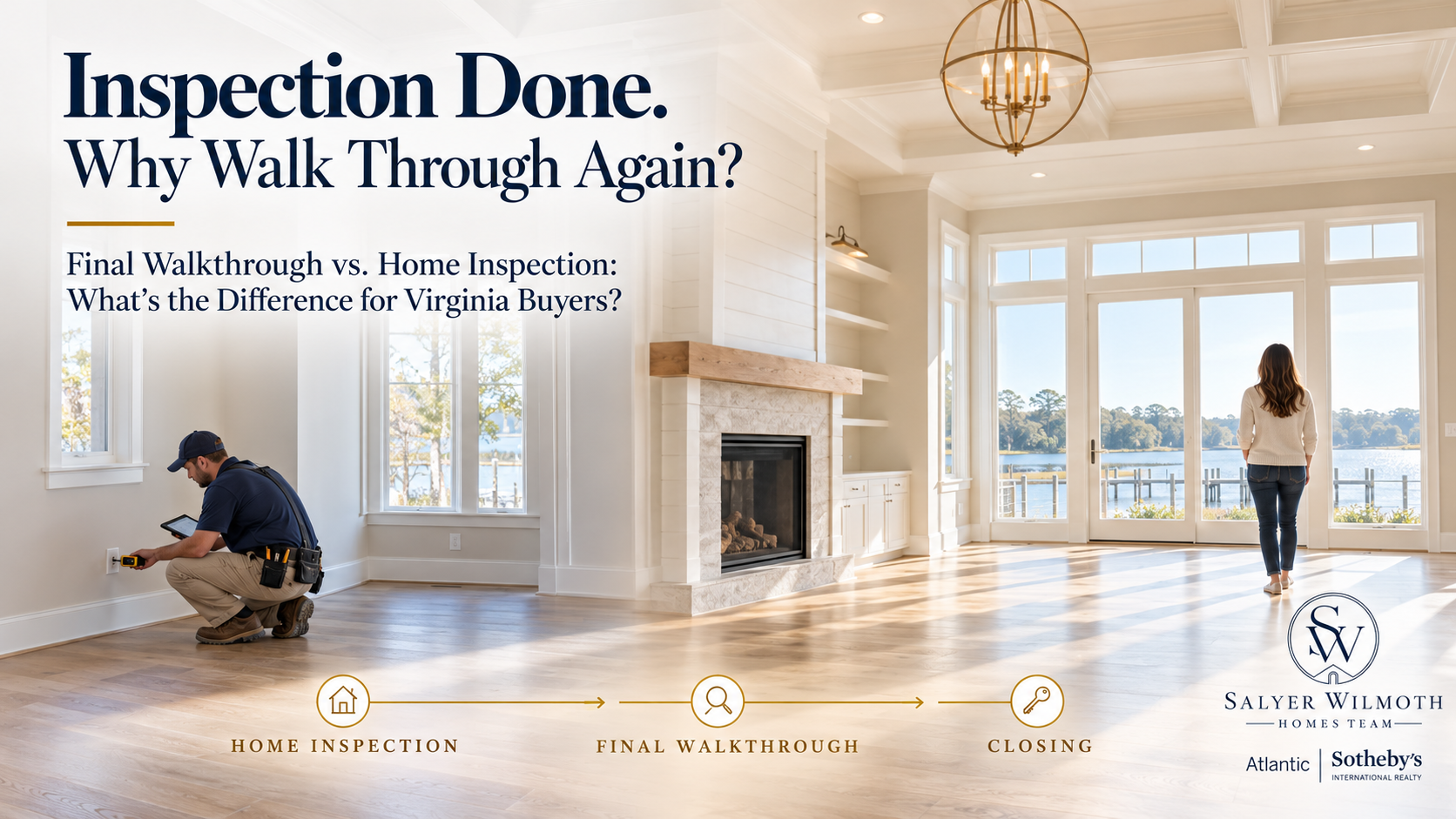
The home inspection and final walkthrough are not interchangeable. A home inspection normally happens earlier in the Virginia purchase process and gives the buyer an opportunity to have a licensed professional evaluate readily accessible systems and components of the home, identify observable defects, and—when the contract includes an applicable inspection contingency—use those findings within the rights and deadlines established by the contract. The final walkthrough happens much closer to settlement and serves a narrower purpose: under the current Virginia REALTORS® Residential Purchase Contract, the buyer receives access for a pre-settlement verification to confirm that the property remains in substantially the same condition as it was at ratification or at the home inspection, depending on the contract selection, and that agreed repairs have been completed. In practical terms, the inspection asks, “What condition is this house in?” while the walkthrough asks, “Is this still the house we agreed to buy?” A walkthrough is not meant to recreate the inspection or open a fresh negotiation over defects that were already present and never addressed. It is the buyer’s final opportunity before settlement to catch issues such as new damage, missing agreed personal property, incomplete repairs, a system that is no longer operating as expected, or a property that was not left in the contractually required condition. Virginia’s current contract language was specifically revised in July 2026 to clarify that purpose, making it especially important for buyers to understand what each stage is—and is not—designed to accomplish. Virginia Realtors
A Home Inspection Answers: “What Am I Buying?”
A home inspection is part of the buyer’s investigation of the property.
In Virginia, a licensed home inspector’s written report evaluates readily accessible components of the residential building. State regulations identify systems and components such as the structure, foundation, framing, roof, plumbing, electrical system, heating and cooling equipment, interior components, exterior components, attic and insulation among the areas that may fall within the required inspection scope, subject to the inspection agreement and accessibility.
That is a much broader exercise than walking through the house a few hours or days before settlement.
The inspector is not simply confirming that the refrigerator is still there.
The inspector is looking at the property as a system and documenting observable conditions for the buyer.
This is why the inspection normally happens while the buyer still has time to evaluate the results and decide what those findings mean within the purchase contract.
When a Virginia transaction includes the current Virginia REALTORS® Home Inspection Contingency Addendum, Form 600D, that inspection contingency is documented separately from the basic purchase contract. Virginia REALTORS® currently publishes the July 2026 version of that form.
For buyers who want the deeper discussion about what can happen after that report arrives, our guide to Home Inspection Surprises in Hampton Roads: What Buyers Can Negotiate in 2026 focuses specifically on inspection findings and the decisions buyers may face during that stage.
The important point here is simpler:
The home inspection is the condition-investigation stage.
A Final Walkthrough Answers: “Is the Home Still as Agreed?”
The final walkthrough happens for a very different reason.
By that point, you may already have completed your inspection, finished repair negotiations, received the appraisal, secured insurance, moved through underwriting, reviewed settlement figures, and scheduled closing.
You are not starting the transaction over.
You are verifying that the property you are about to purchase still matches the agreement.
The July 2026 Virginia REALTORS® Residential Purchase Contract describes this as a Walkthrough Verification. The seller allows the buyer access for a pre-settlement verification within the number of days specified in the contract so the buyer can confirm that the property's condition is substantially the same as it was at either ratification or the home-inspection date, depending on which option is selected, and that agreed repairs have been completed.
Virginia REALTORS® also maintains a current July 2026 Walk-Through Inspection Form, Form 600K, for documenting this stage.
So when I prepare a buyer for the walkthrough, I do not frame it as:
“Let’s see what else we can find wrong.”
I frame it as:
“Let’s make sure nothing important has changed and that the seller did what the contract says should be done.”
That mindset keeps the walkthrough focused on its actual purpose.
The Difference Is Mostly About Timing and Purpose
The easiest way to remember the distinction is this:
The inspection helps you evaluate the home before you fully commit to its existing condition. The walkthrough verifies the agreed condition immediately before you take ownership.
Imagine the inspector finds a leaking dishwasher two weeks after contract ratification.
That is an inspection issue.
The buyer and seller then handle it according to the inspection contingency and whatever agreement they reach.
Now imagine the seller agrees in writing to repair that dishwasher.
You return shortly before settlement and it is still leaking.
That is a walkthrough issue because an agreed repair has apparently not been completed successfully.
Now change the facts again.
Suppose the inspection report mentioned a cosmetic scratch in a bedroom floor, the buyer never requested anything concerning it, and nothing about the floor changed between inspection and closing.
The final walkthrough is generally not intended to become a second opportunity to revisit that old condition simply because the buyer has changed their mind.
That distinction is the reason I want buyers to keep their inspection documents and repair agreement accessible through closing rather than mentally treating the inspection as “finished paperwork.”
The Final Walkthrough Is Not a Second Home Inspection
This is probably the most common misunderstanding.
A buyer may enter the final walkthrough and notice things they did not remember seeing before.
Suddenly the temptation is to start examining every outlet, looking behind every cabinet, scrutinizing every small crack, and wondering whether the entire inspection should happen again.
That is not really what the walkthrough is designed to do.
Virginia’s current contract language specifically focuses the pre-settlement verification on whether the property remains in substantially the same condition as the applicable earlier benchmark and whether agreed repairs have been completed.
A licensed home inspection, by contrast, is a professional evaluation governed by Virginia’s inspection regulations and covers a defined range of readily accessible residential systems and components.
Those are fundamentally different jobs.
If you want a licensed inspector to perform another professional inspection, that is not automatically the same thing as exercising your ordinary walkthrough rights.
Access, timing and any additional inspection need to be considered under the actual contract.
What Should You Look for During the Final Walkthrough?
You do not need to walk through the property as if you have never seen it before.
Start with what changed—or should have changed.
If repairs were negotiated, those deserve attention.
If the seller agreed to leave particular appliances or other personal property, make sure the items that should transfer are still present.
Look for obvious new damage that may have occurred during the seller’s move.
Make sure the home has not been materially altered.
Check the systems and appliances covered by the contract’s walkthrough provisions in a reasonable manner.
Look at the condition of the floors, walls and areas that had previously been hidden behind the seller’s furniture.
If the property has been vacant, pay attention to signs of water intrusion, plumbing problems, HVAC issues or another condition that could have arisen since your earlier visit.
The point is not to manufacture a repair list.
It is to compare the house you are standing in with the house the seller agreed to deliver.
Virginia REALTORS® explains that the current walkthrough provision is intended to ensure that the seller delivers the property in substantially the same condition as the selected earlier benchmark.
For me, the most useful walkthrough is methodical without becoming theatrical.
You are buying the home in a matter of hours.
It deserves your attention.
It does not need a treasure hunt for brand-new objections.
Bring the Repair Agreement With You
This sounds obvious until everyone is standing in the kitchen trying to remember exactly what the seller promised three weeks earlier.
“The seller was supposed to fix the sink.”
Were they?
Or did they agree to repair a specific leak underneath the sink?
Did the agreement require replacement?
A licensed contractor?
A receipt?
A particular remediation method?
Did the parties ultimately agree to a credit instead of a repair?
Memory becomes unreliable surprisingly quickly once inspections, amendments, lending conditions and closing paperwork begin piling up.
If your inspection resulted in negotiated repairs, bring the executed repair document or make sure it is available electronically during the walkthrough.
I would rather compare what we see to the actual written agreement than argue about what somebody remembers from an email thread.
That is also why our Offer Accepted to Closing in Hampton Roads buyer timeline treats the walkthrough as one stage inside a longer contract-to-close process rather than an isolated appointment.
What if an Agreed Repair Was Not Completed?
Do not automatically close your eyes and proceed because settlement is scheduled in two hours.
Also do not automatically assume that every incomplete item gives the buyer an unrestricted right to cancel the contract.
The right response depends on the contract, what was agreed, the nature of the problem and what remedy the parties can reach.
This is especially important under the current Virginia REALTORS® form.
In July 2026, the walkthrough language was revised to remove older wording that had expressly listed three possible buyer remedies when post-contract damage or changes requiring repair were discovered. Virginia REALTORS® explained that the current approach is instead based on the seller’s obligation to deliver the property in the required condition; if that does not occur, the seller may be in breach, and the parties must address the remedy under the agreement and applicable law rather than relying on that former preset list.
In a real transaction, that might mean the agents and settlement professionals begin working quickly to determine whether the issue can be corrected before settlement, documented through an amendment, addressed financially if legally and lender-permissibly appropriate, or handled another way.
If the issue becomes a contractual dispute, the buyer should obtain advice from a Virginia attorney rather than relying on general real-estate guidance.
The walkthrough is meant to reveal the problem before ownership changes hands, when there may still be practical options.
What if Something Broke After the Home Inspection?
This is one reason the final walkthrough exists.
Suppose the HVAC was working when you inspected the property, but it stops cooling three days before settlement.
Or the seller’s movers damage a stair railing.
Or a plumbing leak develops after the inspection.
Those facts are different from a defect that existed during the inspection and was never addressed.
The current Virginia REALTORS® contract includes a seller warranty concerning specified appliances and systems and uses the walkthrough to compare the property’s condition against the contractually selected benchmark.
That means the timing of the problem matters.
I want to know:
Was this already present?
Was it documented during the inspection?
Was a repair negotiated?
Did the condition change afterward?
Those details determine which part of the contract we are actually dealing with.
What if You Waived the Home Inspection?
You can still have a final walkthrough if the contract provides one.
But the walkthrough does not retroactively become the inspection you chose not to perform.
The current standard contract specifically allows the parties to select whether the walkthrough compares the property to its condition at ratification or at the home inspection. Virginia REALTORS®’ contract comparison guidance notes that if there was no home inspection, the relevant systems are tied to their condition at ratification.
That is a meaningful difference.
If you waived inspection to strengthen an offer, you did not secretly preserve a full inspection contingency for closing week.
That is one reason inspection strategy should be considered when the offer is written, not after ratification.
Our guide to making a competitive Hampton Roads offer without overpaying goes deeper into why stronger offer terms should be evaluated against the risk the buyer is actually accepting.
Sometimes buyers intentionally make that tradeoff.
They should still understand what they gave up.
Should Your Home Inspector Attend the Final Walkthrough?
Usually, a routine walkthrough is something the buyer conducts with their real estate agent rather than a repeat professional home inspection.
But there are situations where additional professional review may make sense.
Perhaps an important repair involved a structural component.
Perhaps an HVAC contractor was supposed to complete specialized work.
Perhaps a previously discovered condition required engineering review.
Or perhaps the parties specifically agreed to allow reinspection of a repair.
The correct professional depends on what needs verification and what the contract allows.
The key is not to assume at the last minute that the original inspector will simply reperform the entire inspection during the walkthrough.
If a follow-up inspection matters to your decision, I want it identified and coordinated earlier.
That is one practical benefit of buyer representation throughout the transaction. Our guide to buying a Hampton Roads home without your own agent explains why contract deadlines, inspections and pre-closing coordination involve more than gaining access to listings.
What if the Seller Is Still Moving During the Walkthrough?
This can make the verification harder.
Furniture can hide floors.
Boxes can block walls.
Movers can still cause damage after you leave.
And you may not be able to tell whether all personal property that should be removed will actually be gone by settlement.
If the walkthrough occurs before the seller has completely vacated, I would document what remains unfinished and consider whether another brief verification closer to settlement is appropriate and permitted.
The exact timing is controlled by the contract.
Under the current Virginia REALTORS® purchase contract, the parties fill in how many days before settlement the walkthrough may occur, rather than relying on one universal statewide “24-hour rule.” The current contract comparison materials note that if the timing blank is left empty, the default is the settlement date.
So when somebody tells you, “The final walkthrough is always the day before closing,” that is too broad.
Often, the day before or morning of settlement is practical.
But your actual contract controls.
New Construction Buyers Have an Extra Layer
A new-build walkthrough can feel especially confusing because buyers may have already had builder meetings, municipal inspections, an independent pre-drywall inspection, a final home inspection and a builder punch-list appointment.
Those are not all the same event.
The final walkthrough still serves the transaction’s pre-settlement verification purpose.
A builder orientation or punch-list walkthrough may focus on workmanship and finishes.
A professional new-construction inspection is a separate evaluation.
And a pre-drywall inspection happens much earlier, while framing and rough-ins remain visible.
If you are buying new construction, our Pre-Drywall Inspection Guide for Hampton Roads buyers explains why that earlier inspection cannot simply be recreated after the walls close.
By closing week, your question has changed.
You are no longer asking only:
“What has the builder constructed?”
You are also asking:
“Is the home ready to be transferred to me in the condition our agreement requires?”
Do Not Let Closing-Day Excitement Rush the Walkthrough
Buyers can be understandably distracted on walkthrough day.
The lender has been emailing.
The settlement office wants a document.
Movers are scheduled.
Utilities are being transferred.
Everyone is thinking about keys.
That is precisely why I do not want the walkthrough treated as a ceremonial five-minute lap around the kitchen.
If something is materially wrong, I want to discover it before the deed is signed.
At the same time, I do not want buyers arriving with unrealistic expectations that the walkthrough is the beginning of another unrestricted inspection period.
Both extremes cause unnecessary stress.
The best walkthrough is calm, documented and grounded in the contract.
How Salyer Wilmoth Homes Handles the Inspection-to-Walkthrough Timeline
For a buyer, these two appointments should be connected even though they serve different purposes.
During the inspection stage, we track the applicable contractual deadline, coordinate access, help the buyer organize the questions raised by the inspector, and make sure any negotiated resolution is accurately documented.
After that, we keep the final repair agreement in the transaction file instead of treating it as finished history.
As settlement approaches, I want to confirm that the walkthrough timing makes sense, that the seller has had enough opportunity to complete agreed work and move out, and that we know exactly what needs to be verified when we arrive.
During the walkthrough, we compare the property against the contract—not against an imaginary perfect house.
If an issue appears, we identify whether it is new damage, an incomplete agreed repair, missing property, a system-condition issue, or something that already existed and was never part of the negotiated agreement.
Then we involve the right person.
Sometimes that is the listing agent.
Sometimes the settlement provider.
Sometimes the inspector or contractor.
Sometimes the lender.
And if a genuine legal dispute exists, it belongs with a Virginia attorney.
That is the broader value of keeping the transaction organized from inspection through settlement: the buyer knows what stage they are in and which question they are actually trying to answer.
Frequently Asked Questions
Is a final walkthrough the same as a home inspection?
No. A home inspection is a professional evaluation of the home’s readily accessible systems and components, normally performed earlier in the purchase process. The final walkthrough is a pre-settlement verification that the property remains in the condition required by the contract and that agreed repairs have been completed. Virginia’s current standard purchase-contract language treats the walkthrough as a verification, not a replacement home inspection.
How long before closing should a final walkthrough happen in Virginia?
There is no universal rule that every Virginia walkthrough must happen exactly 24 or 48 hours before closing. Under the current Virginia REALTORS® contract, the parties specify how many days before settlement the buyer may conduct the verification; the current contract comparison guidance says that if the blank is left empty, the default is the settlement date. Practically, buyers often want the walkthrough close enough to settlement that the seller has moved out and completed repairs while still leaving time to address a problem if one appears. If you are buying in Hampton Roads, Salyer Wilmoth Homes can help keep that timing coordinated with the rest of your closing schedule.
Can a buyer back out after the final walkthrough in Virginia?
A final walkthrough does not give a buyer an automatic unrestricted right to cancel simply because they find something they dislike. The buyer’s rights depend on the contract, what condition was discovered, whether the seller failed to satisfy a contractual obligation, and any other applicable terms. Virginia REALTORS® removed language in July 2026 that had expressly listed several preset walkthrough remedies and explained that if the seller fails to deliver the property in the required condition, the issue may instead involve breach and whatever remedy the parties or applicable law provides. Buyers facing a serious pre-settlement dispute should consult a Virginia attorney.
What happens if repairs are not finished at the final walkthrough?
Start with the written repair agreement and determine exactly what the seller agreed to do. An unfinished or unsuccessful agreed repair is different from a defect the buyer simply noticed for the first time at closing. Depending on the circumstances, the parties may be able to complete the work before settlement or reach another documented solution, but financing, settlement and contractual considerations can affect what is possible. If something is incomplete during a Hampton Roads walkthrough, we would first identify what the contract requires and coordinate with the appropriate transaction professionals before the buyer proceeds.
Can I skip the home inspection because I will have a final walkthrough?
Those are not substitutes. The walkthrough is too late and too limited to serve the same purpose as a professional inspection. A licensed Virginia home inspection evaluates readily accessible property systems and observable defects; the walkthrough verifies the agreed condition shortly before settlement. If you are considering waiving or limiting an inspection to strengthen an offer, that decision should be made with a clear understanding of the risk rather than on the assumption that the final walkthrough will give you the same protection later.
A home inspection helps you understand the house you are buying. The final walkthrough helps make sure that is still the house being delivered to you. If you are preparing to buy in Virginia Beach, Chesapeake, Norfolk, Suffolk or elsewhere in Hampton Roads, Salyer Wilmoth Homes can help keep both stages connected to the larger contract-to-close strategy so important inspection findings and agreed repairs do not get lost between ratification and settlement.
This article provides general real-estate information and is not legal, home-inspection, engineering, lending or settlement advice. Inspection contingencies, walkthrough rights, repair obligations and remedies depend on the specific contract and circumstances of the transaction. Buyers should consult the appropriate Virginia attorney, licensed home inspector, lender, settlement provider or other qualified professional regarding their particular purchase.
Michele Salyer, REALTOR®
Salyer Wilmoth Homes Team
Atlantic Sotheby’s International Realty
4416 Expressway Drive
Virginia Beach, VA 23452
757-502-3671
michele@salyerwilmothhomes.com
www.salyerwilmothhomes.com
Virginia Real Estate License #0225238875
North Carolina Real Estate License #322300
Equal Housing Opportunity
Buying a Home in Hampton Roads?
From pre-approval to closing day, we guide buyers through every step of the coastal purchase process.
Comments
Be the first to comment.