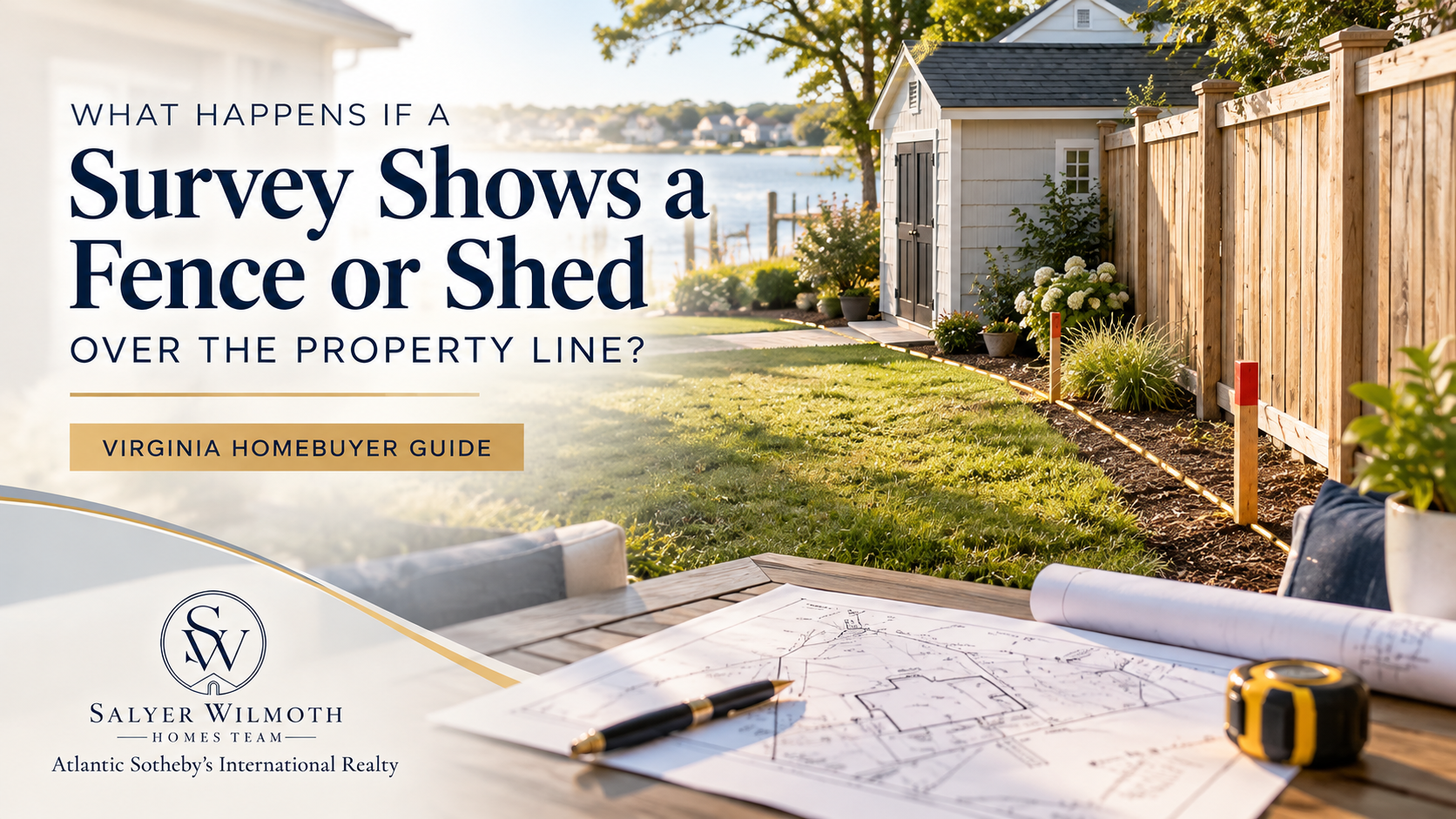
What Happens if a Survey Shows a Fence or Shed Over the Property Line?
TL;DR
If a property survey in Virginia reveals that a fence, shed, driveway, or other improvement crosses a property line, the discovery does not automatically mean the home sale must be canceled. It does mean the buyer and seller need to understand exactly where the boundary lies, what improvement is crossing it, whether the situation affects ownership or title, and how it will be addressed before closing. A neighbor's fence extending onto the property is not necessarily the same problem as a seller's shed extending onto land the seller does not own. Depending on the circumstances, possible solutions may include relocating the improvement, obtaining a properly documented agreement with the neighboring owner, addressing title insurance concerns, renegotiating the contract, or pursuing a formal boundary resolution. Virginia's residential disclosure framework places substantial responsibility on purchasers to investigate lot lines and future improvement restrictions, and a standard home inspection is not a substitute for a survey. For buyers and sellers in Virginia Beach, Chesapeake, Norfolk, Suffolk, and surrounding Hampton Roads communities, resolving an encroachment early can help prevent closing delays, unexpected expenses, and disputes over how the property can be used after the sale.
What Does It Mean When a Survey Shows a Fence or Shed Over the Property Line?
A home can have a neatly fenced backyard, established landscaping, a storage shed, and years of ordinary use without anyone realizing that one of those improvements crosses the legal property boundary.
Then a survey is completed during the sale.
Suddenly, the buyer discovers that the neighbor's fence extends several feet into the yard—or that the shed included with the home sits partly on the adjoining lot.
This is generally called an encroachment: a structure or improvement physically extends onto land outside the property where it is supposed to be located.
The issue can involve fences, sheds, garages, driveways, patios, retaining walls, decks, landscaping structures, and even portions of buildings.
Not every encroachment creates the same level of concern.
A fence that crosses the boundary by a few inches may present a relatively manageable problem if the facts are clear and the neighboring owner cooperates. A permanent structure occupying a substantial part of another parcel can introduce more complicated ownership, financing, insurance, or legal questions.
The first thing buyers should understand is that the visible yard is not necessarily the legal parcel.
A fence may have been placed for convenience rather than precisely along the surveyed boundary. Landscaping may have been maintained for decades by one homeowner even though the recorded boundary lies elsewhere.
And a shed's location does not establish who owns the land beneath it.
In Virginia, the right response begins with identifying the actual boundary, determining how the improvement relates to that boundary, and understanding what legal rights or obligations may exist.
Does the Survey Prove That the Fence Is on the Wrong Property?
A survey can provide important evidence of an encroachment, but buyers should understand exactly what type of survey was performed and what it establishes.
Virginia regulates the work of professional land surveyors through standards that address boundary information and the location of physical improvements.
Under 18VAC10-20-380, surveys determining the location of physical improvements on qualifying parcels must identify relevant fences and structures, including improvements crossing property lines, and show their relationship to those boundaries.
The regulation also recognizes that discrepancies may require a more detailed land boundary survey.
That distinction matters when the available survey raises questions that cannot be resolved simply by looking at a line on a drawing.
A buyer might receive an existing plat from the seller, a recent survey prepared for a previous improvement, or a newly commissioned physical improvements survey. Those documents may differ in age, scope, and the information available to the professional who prepared them.
A current survey can be particularly valuable when an older document does not reflect newer fences, additions, structures, or changes on adjoining properties.
If a drawing indicates a possible overlap, the buyer should ask the surveyor to explain the finding and whether additional boundary work is recommended.
The survey can help establish the physical relationship between the improvement and the surveyed line. It does not, by itself, resolve competing legal claims of ownership, adverse possession, easement rights, or an existing boundary agreement.
Those questions may require review of deeds, recorded plats, title documents, historical evidence, and advice from a Virginia real estate attorney.
Likewise, online property maps and local GIS parcel displays can be useful starting points, but they should not be treated as substitutes for a professionally prepared boundary determination when precise ownership matters.
A Neighbor's Fence on Your Property Is Different From Your Shed on Theirs
One of the most important questions is which direction the encroachment runs.
Imagine a buyer considering an established home in Chesapeake. The newly ordered survey indicates that the neighboring owner's fence extends approximately two feet onto the property being purchased.
The buyer may have expected to own and use the entire area shown within the legal lot boundaries. The fence could affect landscaping plans, yard measurements, privacy, or the location of a future improvement.
But the problem does not necessarily mean that ownership of the strip has changed.
Now consider a different hypothetical property in Norfolk.
The seller's detached shed appears to extend two feet beyond the boundary onto the neighboring parcel.
That creates a different concern. The buyer may be purchasing a property advertised with storage space that depends, at least partly, on land the seller does not own.
The adjoining owner may object to the shed's location, and relocating it could require significant work. The issue may also affect how a title insurer or lender evaluates the transaction.
Neither example necessarily requires canceling the purchase, but they should not be approached as though they are identical.
The location, size, age, permanence, and actual ownership of the improvement matter.
We would want to know not only how far a structure crosses the surveyed line, but also whether the buyer's intended use of the property depends on that particular area.
For someone planning a pool, garage, home addition, expanded driveway, or fenced yard for pets, even a relatively small boundary problem may deserve substantial attention.
Can You Still Buy a Home With a Fence or Shed Encroachment?
Yes. A home with a documented encroachment may still be purchased in Virginia.
The important question is whether the problem can be adequately evaluated and addressed in a way that satisfies the buyer, seller, lender, title insurer, and applicable contract requirements.
Some issues can be resolved before settlement. Others may require a negotiated agreement, additional documentation, or more time.
A buyer might be comfortable proceeding with a minor fence discrepancy after receiving appropriate legal and title guidance. Another buyer may be unwilling to accept a permanent structure crossing the boundary because it interferes with future property plans.
There is also a difference between the buyer agreeing to accept a physical condition and being able to obtain financing or acceptable title insurance for the property.
A seller cannot simply assume that the phrase "as-is" eliminates an encroachment concern or that a buyer must accept any survey issue discovered before settlement.
The signed purchase agreement determines the parties' respective obligations, including the condition of title, applicable contingencies, representations, deadlines, and remedies.
Depending on the circumstances, the buyer may have a contractual opportunity to investigate the issue, negotiate a resolution, or terminate. In other cases, those options may be limited.
The right time to evaluate the effect of the encroachment is before the relevant contractual deadline expires.
What Are the Possible Ways to Resolve a Fence or Shed Encroachment?
Not every property-line discrepancy requires a lawsuit, and not every one can be solved with a simple promise between neighbors.
A workable resolution depends on the actual boundary, the history of the improvement, the rights of the adjoining landowners, and the requirements of the transaction.
One possibility is relocation or removal.
If a fence crosses the boundary, the parties may negotiate for the owner of the fence to move the affected section. A movable shed may also be relocated if its size, foundation, utilities, condition, and the property's available space make that feasible.
However, buyers should not assume that the seller has the authority to remove a structure owned by a neighbor or undertake work on someone else's property without authorization.
A second possibility is a written agreement between the affected owners.
Depending on the circumstances, a properly drafted license or easement may document permission for an improvement to remain. These arrangements do not all create the same property rights.
A license generally provides permission under agreed terms, while an easement may establish an interest or use right affecting the property. The legal consequences, duration, transferability, recording requirements, and effect on future owners must be evaluated by an attorney.
In some cases, the parties may consider a boundary-line agreement, lot-line adjustment, or transfer of a portion of land. Those solutions can require properly prepared and recorded instruments, appropriate lender and title approvals, and compliance with local subdivision or zoning requirements.
A price adjustment or negotiated credit may also be discussed if the buyer is willing to accept the condition and the title and financing issues can be addressed.
But a lower purchase price does not, by itself, correct a defective boundary arrangement or give the buyer rights to land belonging to someone else.
The buyer should understand exactly what remains unresolved after any financial concession.
If the parties genuinely disagree about the boundary, a formal legal process may be necessary.
Virginia Code § 8.01-179 provides a procedure through which a qualifying person with an interest in real estate and a right to possession can seek a judicial determination of a boundary with an adjoining landowner.
That is a formal legal remedy, not an ordinary administrative step in a typical home sale.
A Virginia real estate attorney should evaluate whether it is appropriate and what it means for the transaction.
Who Has to Pay to Move the Fence or Shed?
The cost of correcting an encroachment is often one of the first subjects buyers and sellers want resolved.
But there is no universal Virginia real estate rule that makes every seller responsible for relocating every fence or shed discovered during a survey.
Responsibility depends on ownership of the improvement, applicable law, existing agreements, and the terms of the purchase contract.
If the seller owns a shed that extends onto a neighboring parcel, the buyer may request that the seller resolve the issue before settlement.
If the neighboring owner built a fence across the boundary, the seller may need the neighbor's cooperation to reach a practical resolution.
Neither situation should be treated as automatic proof that a particular party must bear every cost.
The purchase agreement may also influence what the seller is required to deliver at closing and whether the buyer has any right to request correction or withdraw if the problem is not resolved.
Before negotiating, we would want to understand the realistic cost of the proposed solution.
Moving a short section of fence is different from relocating a utility-connected shed on a foundation. A contractor's assessment may be needed, and the proposed work may require local permits or additional approvals.
Buyers should also ask whether the solution can actually be completed before settlement.
If not, the parties may need to discuss an extension or a properly documented arrangement acceptable to the lender, settlement professional, title insurer, and affected property owners.
An informal statement that someone will take care of the problem after closing is not the same as a legally and practically workable resolution.
Will Title Insurance Cover a Property-Line Encroachment?
This is one of the most important questions when a survey identifies a fence or shed crossing a boundary.
Title insurance addresses certain risks affecting ownership rights, but it is not a blanket guarantee against every boundary or survey problem.
The Virginia State Corporation Commission's Consumer's Guide for Title Insurance explains that title insurance provides protection against covered ownership-related losses, subject to the terms of the policy.
Coverage differs between the lender's policy and the owner's policy.
A lender's policy protects the lender's insured interest. An owner's policy is intended to protect the property owner against covered title risks.
The actual coverage depends on the policy form, exceptions, exclusions, endorsements, underwriting decisions, and facts of the particular claim.
A newly discovered encroachment may be identified as an exception, require additional investigation, or lead to a request for corrective documentation before coverage can be issued.
If the problem is known before closing, a buyer should not assume that an owner's title insurance policy will automatically pay to move a fence or protect against every future dispute involving that improvement.
Instead, the buyer should ask the title or settlement professional to explain in writing how the identified issue will be handled, whether any relevant exception will remain, and what coverage is actually available.
A title search and a property survey also serve different purposes.
A title search examines recorded ownership and other interests affecting the property. A survey locates boundaries and physical improvements on the ground.
Together, they can reveal concerns that neither process would fully explain on its own.
For buyers unfamiliar with the sequence of title work, lender requirements, and settlement, our Hampton Roads guide from accepted offer to closing explains why these investigations need to happen before the transaction reaches its final days.
Can a Fence or Shed Encroachment Delay Mortgage Approval or Closing?
It can, although an encroachment does not automatically make a property ineligible for mortgage financing.
A lender may want additional information if a survey identifies an improvement crossing the property line, especially when the concern affects access, use, marketability, or the lender's collateral.
The title insurance underwriter may also need to evaluate whether the property can be insured under the proposed terms.
The situation can become more complicated when the encroachment involves part of the residence, a substantial outbuilding, a shared driveway, or a structure necessary to the buyer's planned use.
Depending on the findings, the parties may need a corrected survey, legal agreement, removal of the improvement, title documentation, or another acceptable resolution.
These steps can affect the closing date.
Buyers should not assume that a mortgage preapproval resolves the issue. Preapproval primarily concerns the buyer's financial qualifications and does not guarantee that every property will satisfy subsequent lender and title requirements.
If the survey reveals a concern, it should be brought promptly to the settlement professional and lender so they can determine whether additional documentation is needed.
For sellers, the same principle applies: discovering a boundary issue shortly before closing may create more disruption than identifying it before the property is listed.
Our guide to what happens after accepting an offer in Hampton Roads discusses how title, appraisal, financing, and other closing requirements come together after the contract is signed.
The sooner an encroachment is evaluated, the more opportunity both parties have to consider a practical solution.
Does a Fence That Has Been There for Years Change the Property Boundary?
Not automatically.
A common assumption is that a fence becomes the legal property line simply because it has existed for many years.
Virginia law is more complicated.
A fence may have been installed based on an inaccurate understanding of the boundary, with permission from the adjoining owner, or under a prior agreement. Its age alone does not establish ownership.
However, long-term possession of land can raise a separate legal question involving adverse possession.
Under Virginia Code § 8.01-236, the general limitation period relevant to recovery of land is 15 years.
Virginia's Supreme Court has explained that acquiring title by adverse possession requires proof of several legal elements, including actual, hostile, exclusive, visible, and continuous possession under a claim of right for the required period. The elements must be established by clear and convincing evidence.
That is a much more demanding legal inquiry than merely showing that a neighbor installed a fence a long time ago.
A visible fence may be relevant evidence, but it does not automatically establish that ownership has transferred.
Permission, the history of possession, the parties' conduct, previous owners, recorded documents, and other circumstances can affect the analysis.
Separate questions concerning prescriptive easements may also arise from certain long-term uses, but those rights should not be confused with ownership acquired through adverse possession.
If the encroachment has existed for many years and either property owner claims a legal right to the disputed area, the buyer should consult a Virginia real estate attorney rather than assume that the survey alone resolves the claim.
For a pending purchase, an unresolved ownership dispute can be more consequential than the physical structure that first revealed it.
Why Property-Line Issues Matter in Hampton Roads
Boundary issues can arise in almost any community, but the property's location and intended use affect how serious the consequences may be.
In established Norfolk and Portsmouth neighborhoods, homes may have older fences, detached sheds, shared access arrangements, small lots, or improvements added by prior owners.
In parts of Chesapeake and Suffolk, larger yards and accessory buildings can make buyers particularly interested in the property's usable land and flexibility for future improvements.
A survey discrepancy may affect where a new fence can be built, whether a shed can be relocated, or whether a planned garage or addition will fit within permitted setbacks.
Waterfront and water-adjacent properties can introduce additional considerations.
A buyer near the Elizabeth River, along Chesapeake waterways, or elsewhere in coastal Virginia may need to evaluate access, easements, shoreline structures, drainage, and environmental requirements alongside the surveyed boundary.
Our article on buying near the water in Deep Creek, Chesapeake explains why buyers should review surveys, easements, property access, and waterfront improvements together instead of relying only on what appears to be part of the yard.
For some properties, the issue may involve more than a fence. A driveway, drainage feature, retaining wall, or structure may cross an easement or sit within an area subject to special restrictions.
A survey can help reveal the physical concern, while the title documents and local regulations help explain the applicable rights and limitations.
This is why the significance of an encroachment should be evaluated in relation to the particular parcel—not simply by how many inches or feet an improvement crosses a line.
What if the Fence or Shed Violates HOA Rules or Local Setbacks?
A structure can be entirely within the property boundaries and still raise a different problem involving zoning, setbacks, easements, permits, or homeowners association restrictions.
That means buyers need to distinguish a boundary encroachment from a zoning or covenant violation.
The two can sometimes occur together, but they are not the same thing.
For example, the City of Chesapeake's fence regulations address fence placement, height, permit requirements, and easements. Its guidance states that fences can generally be placed up to interior property lines unless an applicable easement affects placement.
Virginia Beach also regulates fence location and permits, while its zoning requirements govern setbacks and the placement of accessory structures.
A seller's existing shed may therefore require more than verification that it is on the correct parcel. Buyers may also need to check whether the improvement was properly authorized and complies with applicable location requirements.
This distinction can be particularly relevant in communities with architectural review processes.
An HOA may regulate fence styles, materials, heights, placement, and approvals for exterior improvements. An existing fence does not necessarily establish that the association approved it or that the next owner can replace it in the same configuration.
Our guide to buying in Sawyers Mill, Chesapeake explains how neighborhood rules can affect fencing, sheds, exterior improvements, and other aspects of property use.
For buyers whose plans include a pool, new fence, workshop, or expanded outdoor living area, understanding both the legal boundaries and the development restrictions can prevent expensive surprises later.
Does Virginia Require Sellers to Disclose Property-Line Problems?
Virginia's disclosure framework generally places substantial responsibility on buyers to investigate the property they intend to purchase.
The Virginia Residential Property Disclosure Statement, effective July 1, 2026, specifically addresses current lot lines and the ability to expand, improve, or add structures.
Under Virginia Code § 55.1-703, the required statement generally advises buyers that the owner makes no representations about current lot lines and that purchasers should conduct appropriate due diligence, including considering a survey and contacting the locality regarding zoning, lot coverage, height, and setback requirements.
That makes this issue particularly relevant to prospective buyers who intend to make improvements after closing.
Our earlier guide to Virginia's 2026 Residential Property Disclosure Statement provides more detail about how the buyer-beware framework affects lot-line investigations, zoning research, and future property plans.
However, the general disclosure statement should not be interpreted as permission to make false representations or disregard separate legal, contractual, or professional obligations.
Specific facts may trigger additional requirements, including those involving qualifying pending code or zoning enforcement matters. What a seller or licensee must disclose can depend on the nature of the issue, actual knowledge, representations made, and applicable law.
For sellers who already have a survey showing an encroachment, the prudent approach is to provide the document to the appropriate transaction professionals and obtain legal guidance about how the issue should be handled before making representations about the property.
For buyers, the practical lesson is equally important: do not rely on a listing's lot size, a visible fence, or the apparent yard layout as proof of the exact usable boundaries.
What Should Buyers Do When the Survey Reveals an Encroachment Before Closing?
If a survey identifies a fence, shed, or other improvement crossing the property line, the immediate priority is to understand the finding and preserve the buyer's contractual options.
Start by requesting the surveyor's explanation of the issue.
Determine where the legal boundary is shown, which structure crosses it, the approximate extent of the overlap, and whether further surveying is needed.
Then ask the settlement or title professional to review the finding alongside the legal description, recorded documents, and title commitment.
The buyer should also contact the lender when the encroachment could affect financing or required title coverage.
At the same time, review the purchase agreement with the appropriate professionals to determine which deadlines, contingencies, title requirements, and notice provisions may apply.
A buyer should not assume that a newly discovered survey problem automatically creates an unrestricted right to cancel the purchase or recover earnest money.
The actual contract and applicable law control those rights.
If the problem affects a planned improvement, obtain the information needed to evaluate that impact. A surveyor, contractor, local zoning department, HOA, or other qualified professional may need to provide input.
Only after the nature and likely consequences are understood should the buyer decide whether to request a correction, negotiate a different arrangement, seek an extension, or consider termination if permitted.
At Salyer Wilmoth Homes, our role would be to help keep those moving parts organized: identifying the transaction deadlines, communicating with the settlement and title professionals, coordinating relevant property information, and evaluating how the finding affects the buyer's practical goals.
A boundary discrepancy should be taken seriously, but buyers benefit from understanding the actual issue before making an irreversible decision.
What Should Sellers Do if a Survey Reveals an Encroachment Before Listing?
Sellers are often focused on the home's visible condition when preparing for the market.
They may repair minor defects, repaint rooms, improve landscaping, and prepare the property for photography without considering whether the fence or outbuilding sits precisely within the recorded boundaries.
If a previous survey, neighbor conversation, or other document suggests a possible encroachment, it is worth investigating before the property goes under contract.
This is especially true when the issue concerns a structure that a buyer may consider part of the property's value.
For example, a detached workshop, large storage shed, expanded driveway, or fully enclosed backyard may contribute to a home's appeal.
If the buyer later learns that the feature crosses a boundary, the issue could affect the buyer's decision, the proposed price, the title review, or the closing timeline.
A seller should avoid assuming that a problem is insignificant simply because the neighbors have never complained.
An encroachment that has existed peacefully for years may still create legal or practical uncertainty when ownership changes.
Before listing, the seller can gather available surveys, recorded plats, permits, HOA approvals, and any written agreements relating to the improvement. A surveyor or attorney can help determine whether additional investigation is needed.
If a correction is necessary, addressing it before marketing the home may provide more control over the timing and options.
We would also want to consider how the issue affects the property's presentation and offer strategy. A buyer evaluating a property with a known boundary concern may need additional documentation and time before committing.
Clear information can help prevent a manageable problem from becoming a surprise late in the transaction.
The goal is not to promise that every property-line issue can be resolved immediately. It is to understand what is being sold, identify potential complications, and prepare for the questions serious buyers are likely to ask.
This article provides general Virginia real estate information and is not legal, surveying, title insurance, engineering, or zoning advice. Boundary ownership, easements, adverse possession, encroachment remedies, contract termination rights, and insurance coverage depend on the specific property, applicable law, recorded documents, and transaction terms. Consult a Virginia-licensed land surveyor, qualified real estate attorney, title or settlement professional, and applicable local authorities for property-specific guidance.
Frequently Asked Questions
Can you buy a house if the survey shows a neighbor's fence is over the property line?
Yes. A survey showing that a neighbor's fence crosses the property boundary does not automatically prevent a home purchase in Virginia. The buyer should determine the extent of the encroachment, whether it affects ownership or intended use, and how the title insurer and lender will treat the issue. Possible solutions may include relocation, a properly documented agreement, or another arrangement acceptable to the affected parties. Whether the buyer can require correction, negotiate changes, or terminate depends on the signed purchase contract and applicable law.
Does a fence become the property line after 15 years in Virginia?
Not automatically. Virginia's 15-year limitation period relevant to adverse possession does not mean that every fence standing for 15 years becomes the legal boundary. Adverse possession requires proof of specific legal elements, including actual, hostile, exclusive, visible, and continuous possession under a claim of right for the required period. Permission and other historical circumstances can affect the claim. A survey is important evidence of a boundary discrepancy, but it does not independently decide an adverse possession dispute. A Virginia real estate attorney should evaluate any competing ownership claim.
Who pays to move a fence or shed that crosses the property line?
Responsibility depends on who owns the improvement, the applicable legal rights, existing agreements, and the terms of the real estate purchase contract. A buyer may negotiate for the seller to resolve a known encroachment before closing, but the seller may need cooperation from the adjoining property owner, and no single rule makes the seller responsible for every situation. Salyer Wilmoth Homes can help buyers and sellers coordinate the transaction questions and obtain relevant information before negotiating a resolution. A qualified attorney should determine legal responsibility when the parties disagree.
Does title insurance cover a fence or shed encroachment?
Not necessarily. Title insurance may protect against certain covered claims affecting ownership rights, but survey matters, encroachments, and known conditions can be subject to policy exceptions or exclusions. Coverage depends on the specific policy and endorsements. Buyers should ask the title or settlement professional whether the encroachment is covered, excluded, or requires correction before closing. A lender's policy and an owner's policy also protect different insured interests. The existence of title insurance should never be treated as an automatic substitute for investigating a known boundary problem.
Can I cancel a Virginia home purchase if the survey finds an encroachment?
Possibly, but the survey finding alone does not guarantee an unrestricted right to terminate. The buyer's options depend on the contract's title provisions, applicable contingencies, deadlines, notice requirements, and the nature of the encroachment. Some issues may be resolved through correction or negotiated documentation, while others may affect the seller's ability to deliver the title required by the agreement. If you're buying in Hampton Roads, Michele Salyer and the Salyer Wilmoth Homes Team can help coordinate the relevant transaction information and connect you with the appropriate professionals before a contractual deadline expires.
A survey that reveals a fence or shed crossing the property line does not have to end a promising home purchase, but it deserves more than a verbal assurance that everything will be fine. If you're buying or selling in Virginia Beach, Chesapeake, Norfolk, Suffolk, or elsewhere in Hampton Roads, connect with Michele Salyer and the Salyer Wilmoth Homes Team to discuss the property, identify the questions that need professional review, and understand how a boundary concern could affect your transaction before closing.
Michele Salyer, REALTOR®
Salyer Wilmoth Homes Team
Atlantic Sotheby's International Realty
4416 Expressway Drive
Virginia Beach, VA 23452
757-502-3671
michele@salyerwilmothhomes.com
www.salyerwilmothhomes.com
Virginia Real Estate License #0225238875
North Carolina Real Estate License #322300
Equal Housing Opportunity
Protect Your Deposit Before You Make an Offer
From pre-approval to closing day, we guide buyers through every step of the coastal purchase process.
Comments
Be the first to comment.