What Is a Pre-Drywall Inspection, and Should New Construction Buyers Get One?
TL;DR
A pre-drywall inspection is an independent inspection performed while a new home’s framing and rough plumbing, electrical, HVAC, and other building components are still visible, before drywall permanently conceals much of that work. For many Hampton Roads new-construction buyers, this can be one of the most useful times to inspect because the inspector can observe portions of the structure and mechanical systems that will be difficult or impossible to see during the final home inspection. It does not replace the builder’s required municipal inspections, the final independent home inspection, the walkthrough, or any applicable warranty; it gives the buyer another layer of information at a uniquely useful stage of construction. In Virginia, this distinction is especially important because inspections of new residential structures—including course-of-construction inspections—must be performed by a licensed Virginia home inspector who holds the New Residential Structure, or NRS, specialty. Timing also matters: in Chesapeake, for example, trade rough-ins must be approved before the framing inspection and insulation cannot be installed until the applicable rough-in and framing approvals are complete, while Virginia’s statewide building code requires inspection of structural members and electrical, mechanical, and plumbing systems before concealment. The buyer therefore needs to coordinate access with the builder early enough to catch that short window rather than waiting until drywall is already scheduled.
What Exactly Is a Pre-Drywall Inspection?
The name describes the timing.
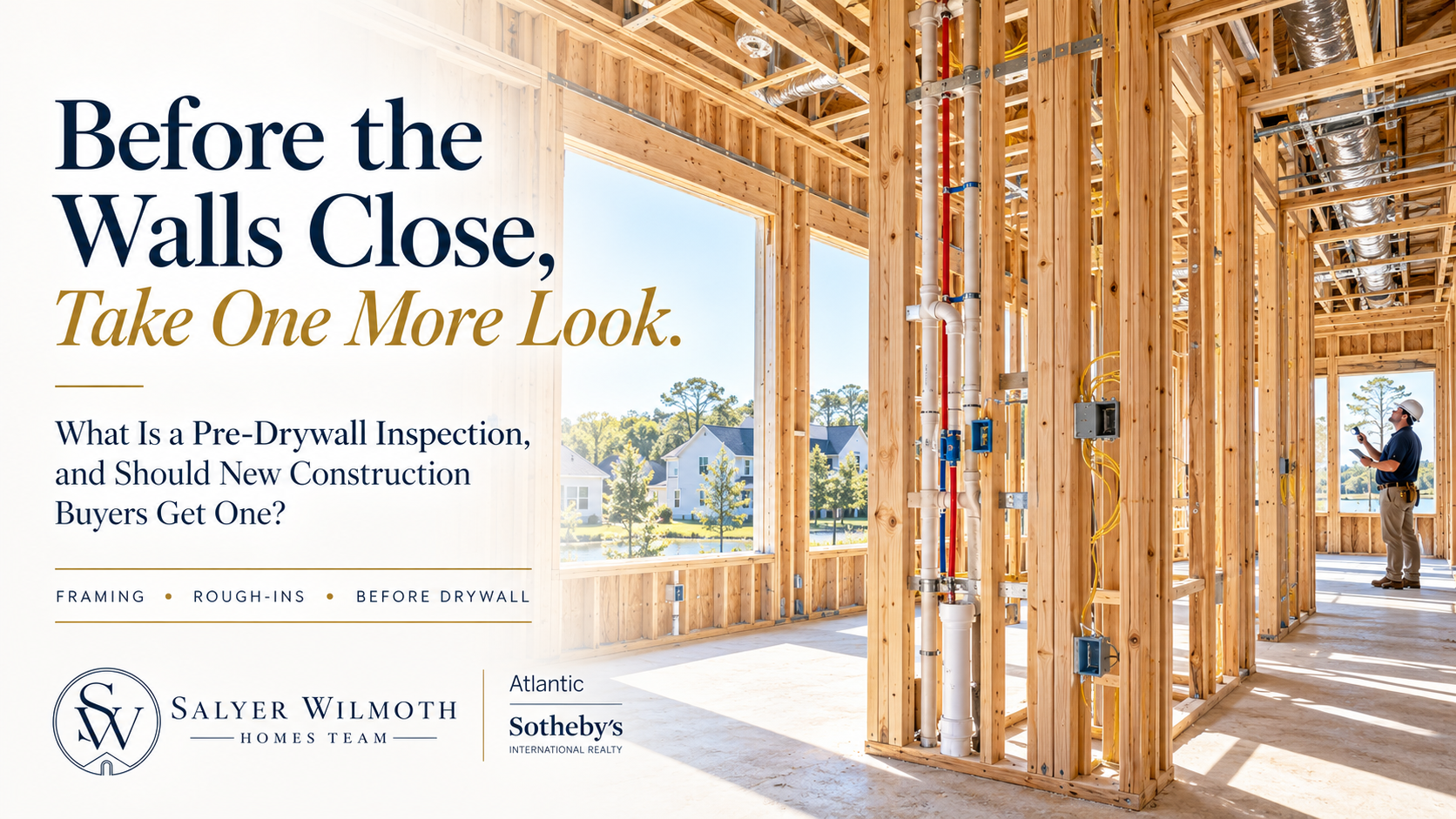
A pre-drywall inspection takes place while the house is far enough along for its structure and major rough-in systems to be visible, but before drywall closes the wall and ceiling cavities.
Walk through a home at that stage and it looks very different from the model home that convinced you to build.
You can see the studs.
Openings in framing.
Electrical wiring and boxes.
Plumbing supply, waste and vent lines.
Ductwork.
Mechanical penetrations.
Structural connections.
Fireblocking and other construction details.
Much of that becomes hidden once insulation and drywall are installed.
Virginia’s building code recognizes this same basic construction sequence by requiring inspections of structural members and fasteners, as well as electrical, mechanical and plumbing systems, before concealment.
That is what makes the timing valuable to a buyer.
The purpose is not to admire how the house is progressing. It is to give an independent inspector an opportunity to observe accessible work before the next phase makes that work considerably harder to evaluate.
When Should a Pre-Drywall Inspection Happen?
There is no useful answer that is simply “three months before closing.”
The construction stage matters more than the calendar.
Ideally, you want the home's framing and applicable rough plumbing, electrical and mechanical work installed and visible, but you do not want the builder to have already covered the areas your inspector needs to observe.
Chesapeake’s residential inspection sequence shows why the window can be narrow. The city describes plumbing and electrical rough-ins as occurring before wall coverage and mechanical rough-in before concealment. Its framing inspection examines structural components after the applicable trade rough-ins have been approved. Insulation comes later and requires a separate inspection before concealment.
Virginia Beach similarly requires rough-in inspections for residential electrical work and mechanical rough-ins for new construction, along with required framing and insulation inspections for new residential buildings.
For an independent buyer inspection, I would want the builder and inspector communicating about the construction schedule rather than choosing a date blindly.
If insulation or drywall is scheduled for Thursday, arranging the inspection for the following Monday defeats the point.
What Does a Pre-Drywall Inspector Look At?
The exact scope depends on the inspector, the stage of construction, what is accessible that day, and the inspection agreement.
That distinction matters.
A private home inspector is not performing the city's permit inspection, and the inspector should not promise that every concealed component complies with every technical provision of the building code.
But the open-wall stage can provide unusually good visibility into several systems that a finished-home inspection cannot examine in the same way.
Depending on construction progress, an inspector may evaluate observable framing and structural components, visible fastening and connections, plumbing routing, electrical rough-in, HVAC ducts and mechanical components, penetrations through framing, visible moisture or damaged materials, insulation if it has already begun, and other readily observable construction conditions.
Virginia’s home-inspection standards require licensed inspectors to evaluate specified accessible and observable components within the scope of the inspection, including structural, electrical, plumbing, heating and cooling, roofing and insulation-related systems.
The important word is observable.
Once drywall covers the wall, a wire that took an unusual route, a damaged framing member, or an inaccessible connection may no longer be observable during an ordinary final inspection.
That does not mean a pre-drywall inspection guarantees perfection.
It means you are choosing to look while you still can.
Is the Builder’s City Inspection Enough?
This is probably the biggest question buyers ask.
The builder absolutely should be obtaining the governmental inspections required for the permitted construction.
Those inspections matter.
They are not something I would dismiss or describe as merely administrative.
In Chesapeake, residential construction can move through footing, foundation, sheathing, plumbing, electrical and mechanical rough-ins, framing, insulation, service, grading and final inspections depending on the project. A final Certificate of Occupancy requires the applicable inspections and required submissions to be complete.
Virginia Beach likewise administers the Uniform Statewide Building Code and requires applicable residential inspections throughout construction.
But the municipal inspector and your private inspector have different roles.
The municipal inspection is part of the permitting and code-compliance process.
Your independent inspector is working for you, under the scope of your inspection agreement, to provide information about the property you are agreeing to purchase.
I do not view those inspections as competing with each other.
They are different layers of review.
In Virginia, Make Sure the Inspector Has the NRS Specialty
This point is particularly important because it is not simply a recommendation.
Virginia regulates inspections of new residential structures differently from inspections of existing homes.
Under Virginia’s Home Inspector Licensing Regulations, a home inspection of a new residential structure, including a course-of-construction inspection, may only be conducted by a licensed home inspector who holds the New Residential Structure specialty.
DPOR describes the NRS designation as authorization for a licensed Virginia home inspector to inspect new residential structures. Inspectors must hold the underlying Virginia home inspector license before qualifying for that specialty.
So if you are calling inspectors for a pre-drywall inspection in Chesapeake, Virginia Beach, Suffolk, Norfolk or elsewhere in Virginia, ask a specific question:
Do you hold the Virginia NRS specialty designation?
I would verify that before scheduling rather than assuming every otherwise qualified home inspector can perform a course-of-construction inspection in Virginia.
Do You Still Need a Final Home Inspection?
I would not treat pre-drywall and final inspections as substitutes.
They answer different questions.
At the pre-drywall stage, you have access to components that will eventually disappear behind finished surfaces.
At the final stage, the home has many things that did not exist—or could not be fully operated—during the earlier inspection.
Fixtures are installed.
Appliances may be connected.
Water is running.
Electrical devices are energized.
HVAC equipment can be operated.
Doors, cabinets, counters, flooring, trim and finishes are present.
Exterior grading may be much closer to completion.
That is why the most useful new-construction inspection strategy can involve more than one look at the property when the contract and builder allow it.
Our broader Home Inspection Surprises in Hampton Roads guide explains the mindset I use once an inspector identifies something: the number of findings matters less than what the important findings could mean for safety, function, future expense and the buyer’s decision.
For a new build, the same principle applies.
The pre-drywall report is information about one stage.
The final inspection evaluates the house much closer to the product you are actually receiving.
What if the Builder Says the House Already Passed Inspection?
That is useful information.
It is not necessarily a reason to skip your own inspection.
If the framing and rough-in work passed the locality’s required inspections, that means the construction cleared those governmental inspection stages.
The buyer can still want an independent review.
In fact, the state building code’s requirement that structural members and rough electrical, mechanical and plumbing components be inspected before concealment helps illustrate exactly why the pre-drywall stage exists as a meaningful checkpoint in the construction process.
I would approach the conversation with the builder professionally:
The buyer is not accusing anyone of poor workmanship.
The buyer is paying for a house that may represent hundreds of thousands of dollars and would like an independent professional to observe it before the walls close.
Those two things can coexist.
Does the Builder Have to Let Your Inspector Onto the Construction Site?
Do not assume that you can simply arrive with an inspector.
The property is an active construction site, and access can be controlled by the builder and by the terms of the contract you signed.
This is one reason the inspection conversation needs to happen before or at the time you sign the builder agreement.
Ask what independent inspections are allowed.
Ask which stages are available.
Ask how much notice the builder requires.
Ask whether the inspector must provide proof of licensing or insurance.
Ask whether a representative has to accompany the inspector.
And ask what happens when the inspection identifies something the buyer wants the builder to review.
If the contract does not clearly address independent inspections, that becomes a question to resolve before assuming you have the same access you would have when purchasing an occupied resale home.
This is one of the broader reasons buyer representation can matter in a builder transaction. Our guide to buying a home without your own agent explains why the person sitting in the builder’s sales office should not automatically be treated as the buyer’s adviser simply because they are helpful throughout the process.
What Happens if the Inspector Finds Something?
A pre-drywall report is not automatically a repair demand.
First, understand the finding.
Some observations may be small corrections that can be handled easily while the work is exposed.
Others may warrant review by the builder, superintendent, electrician, plumber, HVAC contractor, engineer or another appropriately qualified professional.
And some observations may not represent a defect at all once the plans, engineering or construction method are clarified.
This is where I would resist the temptation to send the builder a 60-item report with every observation treated equally.
I would rather understand which findings matter, which need clarification, and which have practical consequences.
Then we look at what the signed builder contract actually allows the buyer to do with that information.
That last point is crucial.
An inspector identifies conditions.
The contract determines the buyer’s legal options.
Do not assume the remedies from a typical resale inspection contingency automatically apply to a builder contract.
The Pre-Drywall Inspection Is Especially Useful Because Corrections May Be Easier Now
Consider a simple example.
If something needs attention inside a wall while the framing is still exposed, the builder may be able to address it directly.
After drywall, paint, trim and cabinetry are installed, accessing the same area may require opening finished surfaces and then restoring them.
That does not mean every pre-drywall finding would become expensive after closing.
It means the construction sequence can make early identification efficient.
That is one reason I would not wait until the final inspection to ask:
“Was there anything we could have seen before the walls were closed?”
By then, the answer may be yes—but the viewing opportunity is gone.
Pre-Drywall Is Not a Punch-List Walkthrough
These two appointments serve very different purposes.
A builder walkthrough near completion usually focuses heavily on the finished home.
You may be looking at cabinet alignment, flooring, paint, trim, doors, fixtures, scratches, incomplete finish work or other punch-list items.
A pre-drywall inspection happens much earlier.
The kitchen might barely resemble a kitchen.
What matters is not the paint color.
It is what is inside the structure before you lose visibility.
For buyers who want a broader look at what happens later in the transaction, our Offer Accepted to Closing in Hampton Roads timeline is useful for understanding how inspections, financing, appraisal, insurance, title and walkthrough eventually converge as settlement approaches.
With a build, that normal closing process is layered on top of a much longer construction timeline.
A Pre-Drywall Inspection Does Not Eliminate New-Home Warranty Rights—or the Need to Understand Them
Virginia law contains implied warranties for qualifying new dwellings, although the statute also sets specific rules governing how warranties may be modified or excluded.
Under Virginia Code § 55.1-357, applicable new-home warranties generally address structural defects, workmanlike construction and, for builders in the business of selling new dwellings, fitness for habitation. The general statutory warranty period is one year from transfer of title or possession, whichever occurs first, while the statutory foundation warranty described in the provision extends five years. The statute also permits warranties to be modified or excluded only under specified conspicuous contractual language.
That means the buyer should read the builder’s warranty materials and purchase contract.
But I would not use the existence of a warranty as the reason to skip an inspection.
A warranty answers the question:
What happens when a covered defect exists?
An inspection asks a different question:
What can we learn about this house right now?
I would rather use both tools for the jobs they are meant to do.
What if You Are Building in Moyock or Currituck Instead?
Cross the state line and some of the same construction logic remains—the value of observing a house before concealment does not disappear—but the licensing rules, builder contract and transaction structure are North Carolina’s, not Virginia’s.
The North Carolina Real Estate Commission has specifically advised that buyers of newly constructed homes should obtain home inspections and that residential home inspectors must be licensed.
For a buyer choosing a new build in Moyock, the pre-drywall inspection should therefore be considered as part of the larger builder-contract strategy rather than borrowed blindly from a Virginia transaction.
Our Buying New Construction in Moyock or Currituck County guide goes deeper into builder contracts, construction fees, upgrades, lot premiums, incentives, warranties, inspections and appraisal considerations.
And if you are deciding between building on the Virginia side and building just across the state line, our Virginia vs. Northeast North Carolina homebuying-process guide explains why two homes only a short drive apart can still involve materially different transaction structures.
How Salyer Wilmoth Homes Would Approach the Inspection Timeline
With new construction, I do not want the inspection discussion to begin when somebody notices drywall stacked in the garage.
The inspection stages should be part of the planning conversation much earlier.
First, we review what the builder contract says about buyer inspections and construction-site access.
Then we identify which inspection stages the buyer wants to use and make sure the inspector meets the applicable licensing requirements.
In Virginia, that means verifying the inspector has the NRS specialty for a new-residential-structure inspection.
From there, the critical piece is communication with the builder.
We want enough notice to know when the home will be ready for the inspection, but we also need to make sure the appointment happens before the builder moves beyond the stage we are trying to observe.
Once the report comes back, we separate meaningful concerns from observations that simply need explanation and determine which questions belong with the builder, inspector, contractor, lender, attorney or another professional.
And we still plan for the final inspection and walkthrough.
A pre-drywall inspection should strengthen the buyer’s information throughout the build—not create the false impression that everything after drywall can be ignored.
Frequently Asked Questions
Is a pre-drywall inspection worth it on a new construction home?
For many buyers, yes. It creates an opportunity for an independent professional to observe framing and rough-in systems before drywall conceals them. Municipal inspectors also inspect construction during these stages, but they serve the code-enforcement process rather than acting as the buyer’s private home inspector. A pre-drywall inspection does not guarantee that no problems will exist, but it can give the buyer useful information at a stage when many components are still visible.
When should I schedule a pre-drywall inspection?
The useful window is generally after the relevant framing and rough mechanical, electrical and plumbing work is substantially in place but before those components are covered by drywall. Construction sequences vary, so buyers should coordinate directly with the builder and inspector instead of choosing a date based only on the projected closing schedule. In Chesapeake, rough-in approvals precede framing and insulation stages, which shows how quickly the inspection window can move once construction reaches this point. If you are buying new construction in Hampton Roads, Salyer Wilmoth Homes can help keep the inspection timing visible as the builder’s schedule develops.
Who can perform a pre-drywall inspection in Virginia?
A Virginia home inspection of a new residential structure, including a course-of-construction inspection, must be conducted by a licensed Virginia home inspector with the New Residential Structure (NRS) specialty. Buyers should verify that designation before hiring the inspector rather than assuming any home-inspection license is sufficient for new construction.
Do I still need a final inspection if I already had a pre-drywall inspection?
Yes, I would treat them as different stages rather than duplicates. A pre-drywall inspection can observe systems and framing while the walls are open, while a final inspection can evaluate components that were incomplete or not operational earlier. Your final home, contract rights and inspection strategy are property-specific, so the goal is to decide which inspections provide useful information rather than assume one appointment can evaluate every stage of construction.
Can a builder refuse a pre-drywall inspection?
Construction-site access and independent-inspection rights can depend on the builder and the contract the buyer signed. Buyers should not enter an active construction site or schedule an inspector without coordinating with the builder. This is something worth clarifying before committing to the purchase. If you are comparing Hampton Roads builders or reviewing a new-construction opportunity, Salyer Wilmoth Homes can help identify the real-estate questions to ask while legal interpretation of the builder contract should be handled by an appropriate Virginia attorney when needed.
The best time to think about a pre-drywall inspection is before the drywall is on the truck. If you are considering new construction in Chesapeake, Virginia Beach, Suffolk or elsewhere in Hampton Roads, Salyer Wilmoth Homes can help you incorporate independent inspections into the larger purchase timeline, coordinate the real-estate side with the builder, and make sure the excitement of watching the house go up does not replace the due diligence that should happen along the way.
This article provides general real-estate information and is not legal, engineering, building-code, construction or home-inspection advice. Inspection rights, construction-site access, builder obligations, warranties and remedies depend on the particular contract, property and jurisdiction. Buyers should consult the builder and the appropriate licensed Virginia home inspector with an NRS specialty, attorney, engineer, contractor, building official or other qualified professional regarding their specific purchase.
Michele Salyer, REALTOR®
Salyer Wilmoth Homes Team
Atlantic Sotheby’s International Realty
4416 Expressway Drive
Virginia Beach, VA 23452
757-502-3671
michele@salyerwilmothhomes.com
www.salyerwilmothhomes.com
Virginia Real Estate License #0225238875
North Carolina Real Estate License #322300
Equal Housing Opportunity
Buying New Construction in Hampton Roads?
From pre-approval to closing day, we guide buyers through every step of the coastal purchase process.
Comments
Be the first to comment.